




























7 Smart Warehouse Technologies to Implement in 2026



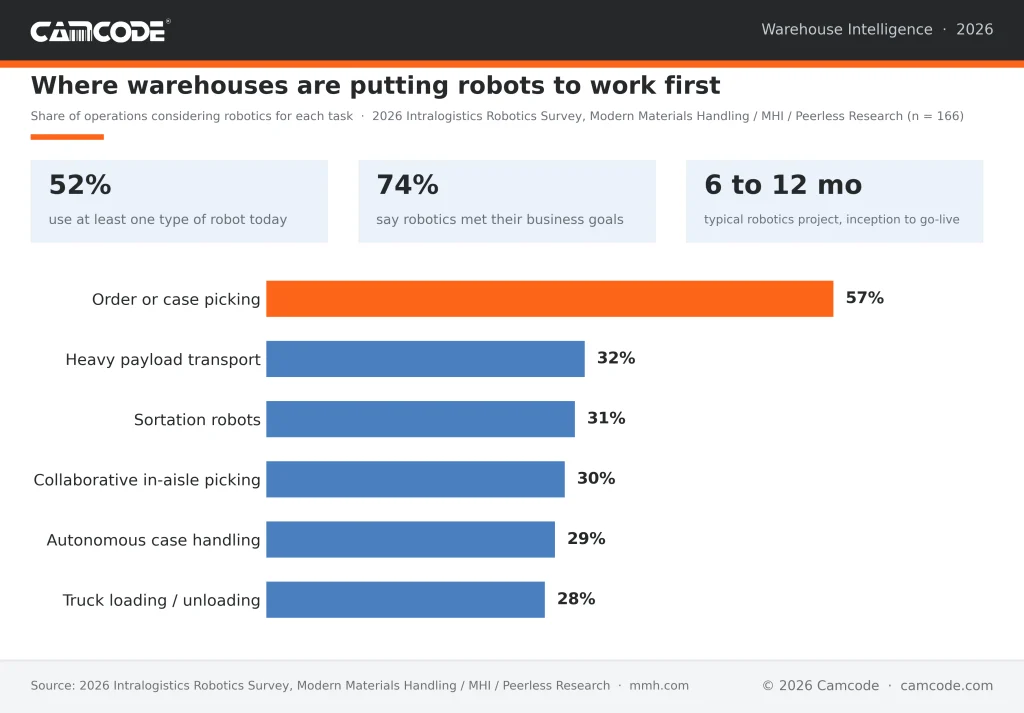
Smart warehouse technologies are no longer a pilot project: 52% of warehouse operations run at least one type of robot and only 3% have no robotics plans, per the 2026 Intralogistics Robotics Survey (Modern Materials Handling and MHI).
Smart warehouse technology is the group of automated systems, including warehouse management software, AS/RS, AGVs and AMRs, cobots, IoT sensors and automated picking tools, that move, store, pick and track inventory while updating stock data in real time. The seven smart warehouse technologies below have the strongest track record, and each entry covers what it does, current adoption data and when it is the right choice.
Smart warehouse technologies are any automated systems that moves, stores, picks or tracks inventory and reports the result to a warehouse management system in real time.
Smart warehousing systems fall into seven groups:
A smart warehouse combines several of these so that inventory location, order status and labor activity are visible without a manual count. In the 2026 MHI Annual Industry Report, 35% of supply chain organizations said they already use robotics and automation and 38% plan to within five years.
John Paxton, CEO of MHI, framed the shift this way when the 2026 Annual Industry Report was released:
“Supply chains can no longer be optimized at the edges. They must be rewired end-to-end. Only connected, intelligent, and automated real-time networks will withstand the volatility and meet the future customer demands for speed and efficiency.”
– John Paxton, CEO, MHI. Business Wire, April 2026
Each of the seven technologies below is one piece of that connected network, and the order you add them in matters.
A traditional warehouse depends on people walking to inventory, paper or handheld pick lists and periodic physical counts. A smart warehouse brings inventory to the picker with robots or AS/RS, confirms every pick with a barcode scan, voice prompt or light, and updates stock levels in the WMS the moment a unit moves.
The practical differences show up in three places: picking accuracy, labor hours per order and inventory visibility. Robotics projects also move faster than conventional automation: 48% of respondents to the 2026 Intralogistics Robotics Survey completed their initiative in 7 to 12 months and 13% in six months or less.
 ■CAMCODE
Smart vs. traditional warehouse
| Process | Traditional warehouse | Smart warehouse |
|---|---|---|
| Receiving | Manual count against the packing slip | Dock-door RFID or barcode scan posts receipts to the WMS on arrival RFID / barcode |
| Putaway | Worker chooses a slot from memory | WMS directs the slot; AGV or AS/RS moves the pallet WMS + AGV / AS/RS |
| Picking | Paper or handheld list, picker walks to every slot | Pick-to-light, voice or AMR brings work to the picker; every pick confirmed by scan Picking tools + AMR |
| Inventory count | Quarterly or annual physical count | Continuous cycle count from scans, RFID reads and sensors RFID + IoT |
| Reporting | End-of-day or end-of-week | Real-time dashboards from the WMS and IoT feeds WMS + IoT |
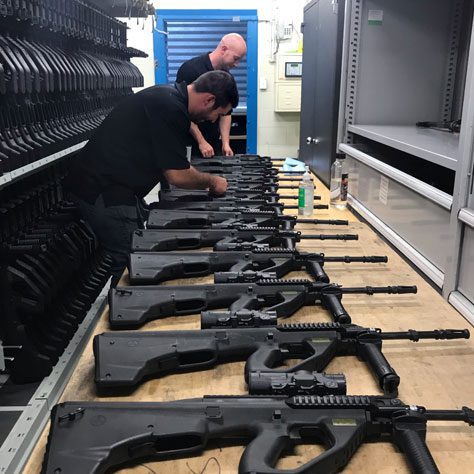
Long gone are the days of error-riddled picking; now, warehouses can benefit from near-perfect picking rates when picking automation elements are integrated into the flow. There are a variety of different tools that can be used to boost picking procedures, such as voice automated order picking, robotic order picking, and pick-to-light. These technologies also make use of cutting-edge barcoding options that integrate seamlessly with your chosen management software for the fastest, most accurate automated reporting experiences.
There’s no better way to ramp up your storage and retrieval processes than to integrate automatic guided vehicles, otherwise known as AGVs, into your warehouse. The structural integrity of AGVs are evolving as technology moves forward, but even the models that have been on the market for some time have proven to be safer and yield a quicker ROI than manual labor. Some of their most important functions include pallet, rack, and other container storage, and even functions that control and automate the entire receiving process.
When used in conjunction with a handful of other technological mainstays, such as asset and inventory tags, automated inventory control platforms are implemented to take the labor, guesswork, and extraneous time out of traditional inventory control. To sweeten the deal, most of these platforms are built to automatically count the inventory and synthesize the data for fast, real-time, and ultra-accurate reporting that can be accessed remotely.
Warehouse Management Systems, otherwise known as WMSs, are comprehensive software systems that wrangle all of your important data into one platform that can be easily accessed by internal players as well as any chosen members of your supply chain. This compartmentalizing of data makes for lightning-fast reporting which, when used tactfully, can mean uber-efficient planning, even for the scenarios that you didn’t see coming. All in all, the use of warehouse management – or warehouse execution – systems perfectly complements other automated elements.
The Internet of Things, or IoT, is more of an overarching concept than an individual technology, but it is regularly put into place in the world’s most effective smart warehouses. When IoT is utilized to control a plethora of moving parts, both automated and manual, it can optimize all of your processes so that their data lives in one, easy-to-access network. This helps to optimize a warehouse’s inventory control procedures, labor planning, and, of course, its overall customer experience through more rapid fulfillment rates.
We’ve spoken briefly about the benefits of fully autonomous and robotic technologies, but it’s not always feasible for every warehouse to immediately embrace such technology, especially considering that this implementation requires sizable funds and infrastructure changes. That’s why more and more warehouses are embracing collaborative robots, or cobots, autonomous elements that are built to work with your existing associates, not without them. Cobots allow warehouses to keep many of their processes and infrastructure design choices intact while still benefiting from the optimized workflow that fully autonomous elements provide.
Automated storage and retrieval systems have been around for years, and though they have done their job of improving throughput and accuracy, they have often been regarded as being expensive, clunky, and generally inflexible. Having said that, today’s AS/RS’s are only getting sleeker and still tout all of their original benefits–reduced labor costs/restraints, modular possibilities, and, of course, increased accuracy.
You don’t need to complete a comprehensive overhaul of your warehouse to make it smarter and more efficient; instead, introduce the technologies that make sense for your business and all of its processes first. Then, you will see that any warehouse can become a “smart” warehouse.
Our sales engineers are experts in automatic asset tracking, tagging and identification, and can answer all your questions. Get in touch now.
Lets Talk ›Enter your information and get a free checklist of the top questions to answer and tips to plan a successful asset tagging project for any warehouse management system implementation.