






































What is Warehouse Operations? How Does It Work?



Warehouse operations means the daily processes a warehouse runs to receive, store, pick, pack and ship goods. The United States had 23,757 private warehousing and storage establishments at the end of 2025 and 1.84 million warehousing employees as of June 2026, according to the Bureau of Labor Statistics.
Whatever the size of the building, warehouse operations has one goal: fill every order accurately and on time while using space, equipment and labor efficiently.
This guide explains what warehouse operations includes, how each core process works, which KPIs measure performance and the best practices that keep a warehouse running well. Warehouse automation has changed the tools, but the fundamentals below apply to a 10,000-square-foot parts room and a million-square-foot fulfillment center alike.
Rick Stinchcomb of the University of Oklahoma Press defines warehouse operations as such: “The goal of warehouse operations is to satisfy customers’ needs and requirements while utilizing space, equipment, and labor effectively. The goods must be accessible and protected. Meeting this goal requires constant planning and ongoing change.”
Breaking it down, warehouse operations covers a number of important areas, from the receiving, organization, fulfillment and distribution processes. These areas include:
Of course, the aforementioned points represent just a fraction of what many modern warehouse operations managers face. They constitute the fundamentals of warehousing, elements that serve as the building blocks for all warehouses, big and small.
While many factors come into play when considering warehouse operations, today’s key factor concerns customer experience. Since the rise of Amazon and its nearly autonomous fulfillment centers, consumers have grown accustomed to two-day, one-day, or sometimes even hourly shipping times.
These expectations force warehouse operations to keep customers’ needs at the forefront. Operations can achieve this by investing in a software system, like a WMS, WES or CRM that give all members of the supply chain, including customers, a picture of the retailer’s inventory levels.
The operations manager, along with planners and other management, can use the purchase data to organize the warehouse floor in such a way that the most popular or quick-moving SKUs are strategically placed. Once the inventory and infrastructure plans have been inked, management must also consider factors like new technology integration, picking routes, safety, personnel management and more.
Attention must also be paid to the organization’s fleet, whether it be internal or otherwise. It is the job of the warehouse operations personnel to ensure that all inventory is picked, packed and ready to be loaded for shipment in the most efficient way possible.
Warehouse operations follow six core processes, in order: receiving, putaway, storage and inventory control, order picking, packing and shipping. Each one hands off to the next, so an error upstream (a pallet put away in the wrong bay, a carton received without a label) shows up downstream as a mispick, a stockout or a late shipment.
The interactive walkthrough below shows what happens at each step, the KPI that measures it and where the process usually breaks.
 CAMCODE
Interactive walkthrough
CAMCODE
Interactive walkthrough
Click any step to see what happens, the KPI that measures it and the most common failure point. Every step depends on the one before it.
Warehouse operations vary by the type of facility. The main types of warehouses are:
A fulfillment center runs picking-heavy operations with thousands of small orders a day, while a distribution center moves pallets and cases in fewer, larger shipments, so the layout, equipment and KPIs differ even though the core processes are the same.
Where the warehouse sits in the wider network of inbound freight, storage and outbound transportation is the subject of warehouse logistics.
Warehouse operations management is the planning, staffing and daily supervision of everything that happens between the receiving dock and the shipping dock.
A warehouse operations manager is responsible for hiring, training and scheduling the warehouse team, setting productivity and accuracy targets, planning the layout and slotting of inventory, maintaining the warehouse management system and the labeling it depends on, enforcing OSHA safety rules and coordinating with purchasing, planning and transportation so inbound and outbound volume matches labor and dock capacity.
Typical responsibilities include:
Maintaining a reliable, safe, and modern warehouse can be possible for operations of all sizes and budgets, provided that the basic best practices are followed. These include:
To improve warehouse operations, start with the data the warehouse already produces and fix the largest source of wasted time. The highest-return changes are:
Warehouses that cannot hit targets with process changes alone then evaluate conveyors, goods-to-person systems or autonomous mobile robots, which Prologis reports now run in roughly 30% of modern logistics space.
Our guide to warehouse optimization covers layout and slotting changes in more depth.
A warehouse that cannot exchange data with the rest of the business becomes a blind spot. Integration between the WMS and the company’s other systems gives purchasing, sales and transportation the same inventory picture the warehouse floor sees.
Warehouse operations must be tightly integrated with systems such as:
ERP systems serve as the central hub for managing business processes, including inventory management, order processing and financial operations. Integrating warehouse operations with ERP systems ensures real-time data exchange, enabling accurate inventory tracking, efficient order fulfillment and accurate financial reporting.
TMS solutions handle transportation planning, execution and freight management. By integrating warehouse operations with TMS, businesses can coordinate inbound and outbound logistics, plan transportation routes and reduce transportation costs while improving delivery times.
For businesses with an online presence, integrating warehouse operations with eCommerce platforms is essential for efficient order processing, inventory management and timely order fulfillment. This integration enables real-time updates on product availability, order status and shipping information, which improves the customer experience.
The benefits of integration and connectivity in warehouse operations include:
The 2026 MHI Annual Industry Report, produced with Deloitte, makes the same point about the limits of fixing one system at a time. As John Paxton, CEO of MHI, put it:
“Supply chains can no longer be optimized at the edges. They must be rewired end-to-end.”
– John Paxton, Chief Executive Officer, MHI. MHI and Deloitte 2026 Annual Industry Report announcement, April 2026.
For a warehouse, “end-to-end” starts with the WMS talking to the ERP, the TMS and the storefront, which is exactly the integration list above. The same report found that 56% of supply chain leaders plan to increase innovation spending, with 52% planning to spend more than $1 million.
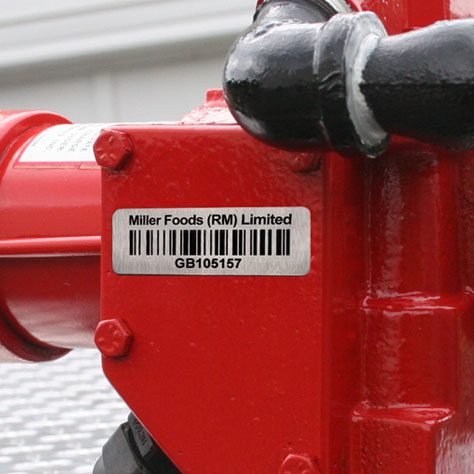
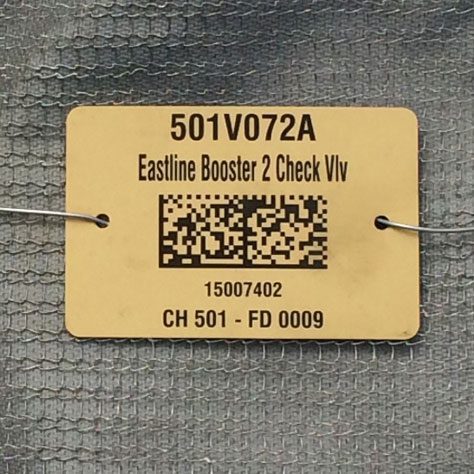
Warehouse operations technology includes warehouse management systems (WMS), barcode and RFID labels, handheld scanners, conveyors, sortation, automated storage and retrieval systems (AS/RS), autonomous mobile robots (AMRs) and goods-to-person picking. A WMS directs every task. Warehouse labels on racks, bins, pallets and products give it the location and inventory data it runs on.
No automation investment pays off if the locations it moves goods between are unlabeled or mislabeled.
Adoption is rising. 39% of supply chain leaders now rate robotics and automation as having a significant or greater impact on their operations, up 16 points in one year, while 48% say the same of AI, according to the 2026 MHI Annual Industry Report. Roughly 30% of modern logistics space uses automation today, up from 20 to 25% five years ago. Prologis expects that share to reach 50% by 2035.
Prologis Research also found that modular systems, which target one bottleneck such as picking or sorting, need about one-third the capital of a fully automated building and deliver roughly 1.5 times the throughput per dollar.
As Melinda McLaughlin, Senior Vice President and Global Head of Research at Prologis, told Logistics Management:
“Modular systems help preserve flexibility. Companies can scale up or down as needs change, without being locked into fixed infrastructure.”
– Melinda McLaughlin, Senior Vice President and Global Head of Research, Prologis. Logistics Management, April 2026.
That is the practical order of operations for most warehouses: label and scan first, fix the process, then automate the step that still limits throughput.
Warehouse operations KPIs are the metrics managers use to measure how well a warehouse receives, stores, picks and ships inventory. The most important warehouse KPIs are order accuracy, inventory accuracy, on-time shipment rate, dock-to-stock time, picking productivity (lines per labor hour), cost per order and space utilization.
Order accuracy measures orders shipped with the correct items and quantities. Inventory accuracy compares WMS counts to physical cycle counts. On-time shipment rate is the share of orders shipped by the promised date. Dock-to-stock time is the hours from receipt to putaway. Cost per order divides labor, space and equipment cost by orders shipped.
The key performance metrics most warehouses report on fall into five groups:
Order Accuracy and Fulfillment Rates: Measure the percentage of orders that are picked, packed, and shipped correctly and on time. These metrics directly impact customer satisfaction and loyalty, making them crucial for businesses focused on delivering exceptional service.
Inventory Accuracy and Cycle Counting: Inventory accuracy is essential for maintaining optimal stock levels, reducing stockouts or overstocking and ensuring efficient order fulfillment. Cycle counting, a process of regularly counting and verifying a subset of inventory, helps maintain inventory accuracy and identify discrepancies.
Labor Productivity and Utilization: Labor is a significant cost factor in warehouse operations. Monitoring labor productivity and utilization metrics, such as orders processed per hour or lines picked per hour, helps optimize workforce allocation, identify training needs and implement process improvements.
Space Utilization and Slotting Optimization: Efficient space utilization and slotting optimization ensure optimal use of available warehouse space, reducing wasted space and improving picking and putaway efficiency. Metrics like cubic space utilization and travel distance can guide layout optimization and slotting strategies.
Transportation and Logistics Costs: Monitoring transportation and logistics costs, including inbound and outbound freight costs, helps identify opportunities for cost savings and optimizes the overall supply chain network.
To track these metrics, businesses should implement data collection and analytics tools, such as warehouse management systems (WMS), business intelligence (BI) dashboards and data visualization platforms. These tools provide real-time visibility into warehouse operations, enabling data-driven decision-making, continuous improvement and proactive problem-solving.
The biggest warehouse operations challenges in 2026 are labor availability, inventory accuracy, space constraints and the pace of technology change.
Warehousing employment sits at 1.84 million jobs, according to the Bureau of Labor Statistics, yet MHI ranks the talent gap as the top supply chain issue for 2026. Inventory accuracy suffers when locations are unlabeled or scans are skipped, which leads to mispicks and stockouts. Space constraints push warehouses toward higher racking, narrower aisles and better slotting.
Companies are responding with barcode and RFID labeling, warehouse management systems, daily cycle counting and modular automation.
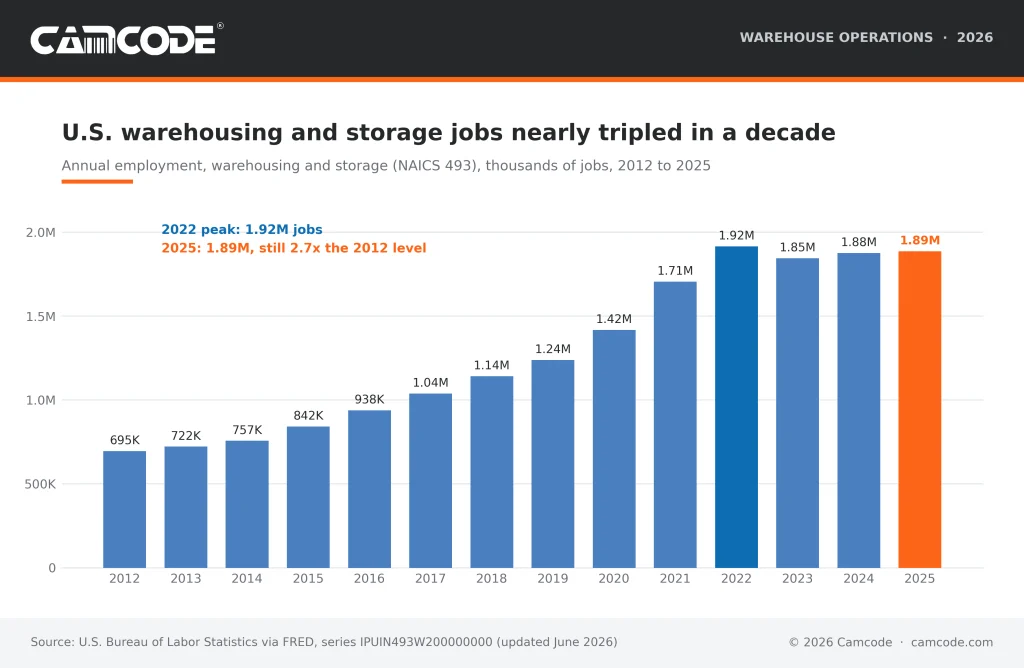
Employment tells the same story. Warehousing jobs rose from 695,000 in 2012 to a 1.92 million peak in 2022 before settling at 1.89 million in 2025, according to BLS data, so the industry is running near-record headcount while labor productivity in warehousing and storage grew just 0.1% in 2024. That gap between headcount and output is why the technology investments described above are accelerating.
As you can see, modern warehouse operations have evolved into a rather involved field, but that doesn’t mean that the basics have changed. Always put the customer first, focus on fulfillment times and keep a regimented study on facility safety and organization. By following these steps, you, too, will have the tools you need to run an efficient enterprise. If the warehouse is still running on unlabeled locations and clipboard counts, start there: accurate location labels are the cheapest fix on this page and every other improvement depends on them.
the key principles of efficient warehouse operations are:
These three core operations – receiving inbound goods, fulfilling orders by picking and packing, and shipping outbound orders – form the backbone of most warehouse operations.
The five warehouse processes most guides list are:
Packing is also often treated as part of picking or as a sixth step.
Receiving checks and logs inbound goods, putaway moves them to a scanned storage location, storage holds and counts them, picking retrieves items for orders, packing verifies and boxes them and shipping loads and dispatches the orders.
Every process depends on accurate location labels and a warehouse management system to record each handoff.
Receiving is the first step in warehouse operations. Inbound shipments are scheduled to a dock door, unloaded, counted against the purchase order or advance shipping notice, inspected for damage and scanned into the warehouse management system.
Nothing should move to storage until it has been received in the system, because every downstream process (putaway, picking, shipping) relies on the quantity and location data created at receiving.
Warehouse operations and warehouse management are related but not the same.
Warehouse operations is the physical work: receiving, putaway, storage, picking, packing and shipping.
Warehouse management is the planning and control layer above that work: setting the layout, choosing a warehouse management system, scheduling labor, setting KPI targets and deciding how inventory is slotted and replenished.
Warehouse operations management sits between the two and refers to the daily supervision that turns the management plan into completed orders.
The seven types of warehouses most often cited are:
Cross-dock facilities are sometimes counted as an eighth type.
Each runs the same core warehouse operations processes, but the mix of pallet versus each-picking, storage time and equipment differs by type.
Our sales engineers are experts in automatic asset tracking, tagging and identification, and can answer all your questions. Get in touch now.
Lets Talk ›Enter your information and get a free checklist of the top questions to answer and tips to plan a successful asset tagging project for any warehouse management system implementation.