














How to Generate a PDF417 Barcode:
Here’s how to use the free PDF417 barcode generator from Camcode.
Follow these five simple steps:
- Enter your content in the Barcode Contents field. PDF417 accepts text, numbers and ASCII characters.
- Set the error correction level: Level 2 to 5 is the ISO-recommended range for typical label data; go higher for labels that face abrasion or weather.
- Check the live preview to confirm the symbol renders cleanly.
- Export the barcode as a vector SVG and place it in your label, ID card or shipping label artwork at 100 percent scale.
- Test-scan a printed sample with a 2D imager or smartphone camera before a production run.
The PDF417 barcode generator includes all 27 symbologies from our free barcode generator, grouped by family. Pick a linear code, a high-density 2D format or a smart QR action from the same screen.
What is a PDF417 Barcode?
PDF417 is a high-capacity, stacked two-dimensional (2D) barcode format that stores text, numbers and binary data. It is defined in the ISO/IEC 15438 standard and was invented in 1991 by Ynjiun P. Wang at Symbol Technologies. The name describes the geometry: PDF stands for Portable Data File and 417 means each codeword is built from 4 bars and 4 spaces across 17 modules.
A PDF417 symbol is a stack of 3 to 90 short linear barcodes read as one. That stacked structure is why it behaves differently from matrix codes like QR: the symbol grows taller as you add data, some older laser scanners can read it line by line and its width stays predictable on a label. At full size one symbol holds up to 1,850 text characters, 2,710 digits or 1,108 bytes of binary data.
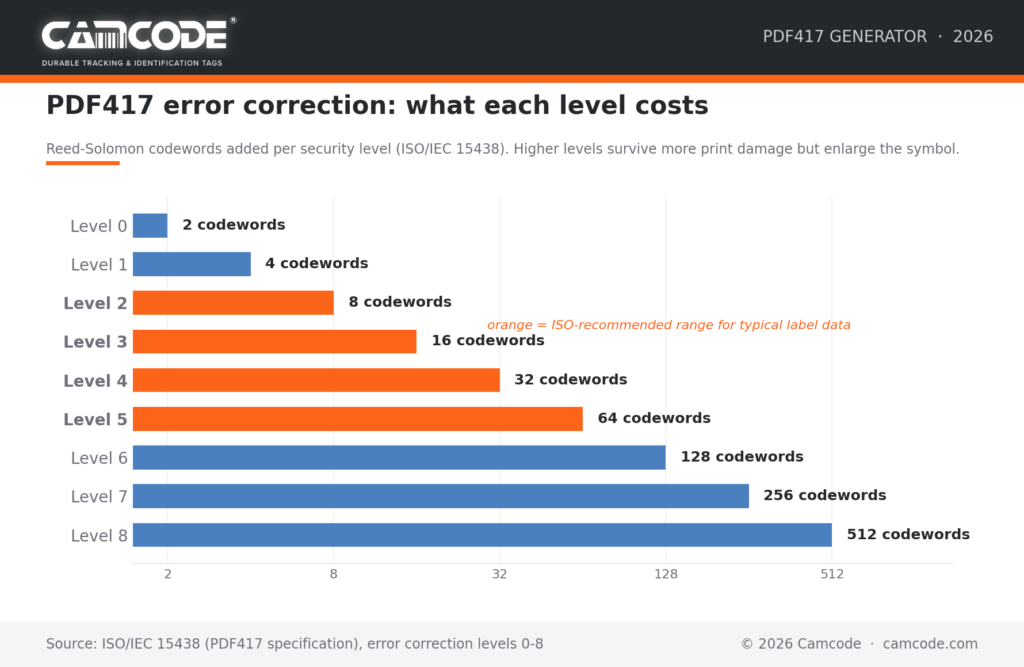
Every symbol carries Reed-Solomon error correction, set by the security level you choose in the generator above; the chart above shows what each level adds. PDF417 is public domain, so there are no license fees to print it at any volume.
For how it compares with the other 26 symbologies in this tool, see Camcode’s complete guide to barcode types and standards.
How Much Error Correction Do You Need?
Every PDF417 symbol reserves part of its area for Reed-Solomon error correction. The security level you pick in the PDF417 barcode generator decides how much. Each step up doubles the recovery codewords, from 2 at level 0 to 512 at level 8, so protection compounds fast and so does symbol size.
The chart below shows what each level adds; for most printed labels the ISO-recommended range of levels 2 to 5 is the right starting point.

Need Barcode or QR Code Labels?
Camcode is a developer and manufacturer of customized, durable asset tracking labels and automatic data capture tracking solutions for applications where permanent identification is critical. With over 50 years experience, we can create the perfect tracking solution for your asset, facility, maintenance, or warehouse management project. Contact us now to how you can start tracking better today.
A Worldwide Leader in Durable Labels
The makers of labels that go anywhere.
From your utility box to outer space, Camcode’s durable pre-print barcode labels track millions of assets and locations across the globe.
Why do you need durable labels? Camcode’s asset tags improve the efficiency of asset tracking systems by eliminating human error. Our proprietary manufacturing processes and coating technologies offer the ultimate durability for practically every application.


Asset Tags Made Specifically for Your Application
Camcode has the experience to provide the right labels for any application. Learn more about our label offerings for your industry, or Contact Us to get help from one of our experienced sales engineers now.
Get a Free Barcode & QR Code Label Sample Kit
Request a free asset label sample kit today and we will send you a kit to test our extremely durable labels in your own operating environment.
Frequently Asked Questions:
PDF417 is a stacked, two-dimensional barcode symbology standardized as ISO/IEC 15438. The name stands for Portable Data File 417: each codeword uses 4 bars and 4 spaces across 17 modules.
One symbol encodes up to 1,850 ASCII characters, 2,710 digits or 1,108 bytes of binary data, far more than a linear barcode, which is why identification documents use it. Reed-Solomon error correction lets scanners recover the encoded data from smudged or damaged symbols. PDF417 is public domain, so you can generate and print it without licensing fees.
PDF417 barcodes support:
- Text and alphanumeric data
- Numeric values
- Special characters
- Binary data (e.g., encoded files or structured records)
They can store significantly more data than traditional 1D barcodes.
PDF417 barcodes are widely used in:
- Government-issued IDs (e.g., driver’s licenses)
- Boarding passes and transport tickets
- Logistics and shipping labels
- Document management systems
Key benefits include:
- High data capacity
- Built-in error correction
- Ability to encode structured and complex data
- Scalable size depending on data requirements
PDF417 requires a 2D imager or camera-based device; a laser scanner built only for 1D linear barcodes cannot read it. Most modern handhelds and any current 2D barcode scanner app on a smartphone read PDF417 without special configuration.
If your fleet still runs 1D-only laser scanners, test one unit against a generated sample before committing to PDF417 labels.
Yes, PDF417 is still used today. In 2026 it remains the required barcode on U.S. and Canadian driver’s licenses under the AAMVA card design standard. It still appears on boarding passes, vehicle registrations and structured shipping documents.
Newer matrix codes such as QR and Data Matrix now dominate consumer and industrial marking, but identity documents continue to rely on PDF417 and no replacement has been announced.
Keep Operations Efficient with Facility Management Asset Tags
Find exactly what you need. And, if you don’t find it, build it with Camcode. Talk to our team today.